One spot
Use the same outdoor area and a short cue such as “go potty.”
Helping you understand your little low rider from puppyhood and beyond.
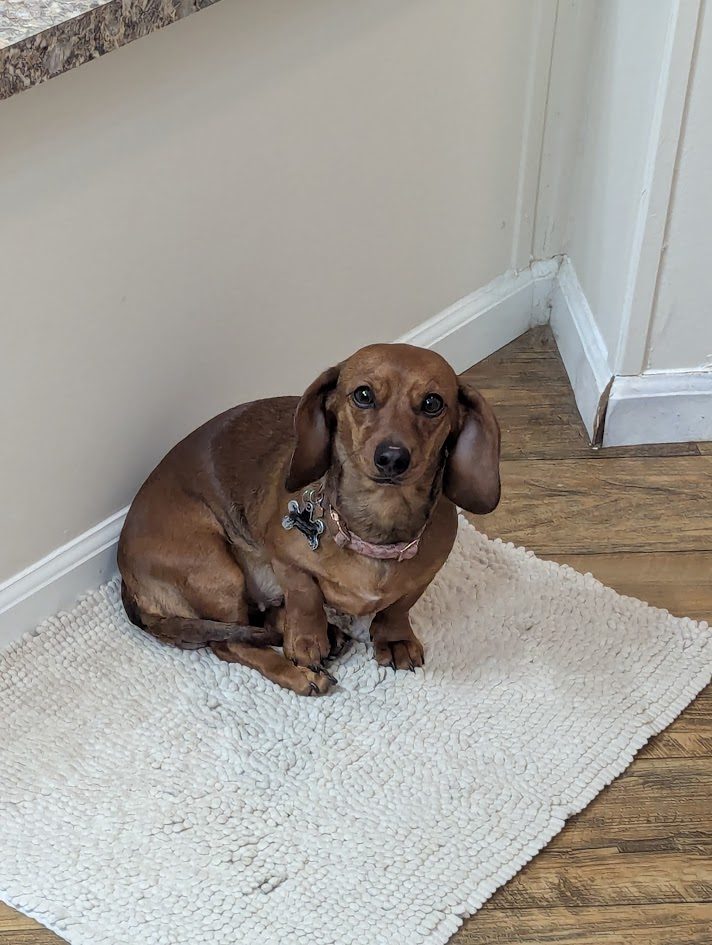
Bringing home a miniature dachshund is wonderfully exciting. Their intelligence, determination, attachment to their people, long backs, short legs, and very big personalities also mean there are a few things every dachshund family should know. This is the practical, family-to-family advice we want our puppy homes to have close at hand.
Need help with something right now? Jump straight to the answer.
Dachshunds originated in Germany. Their name literally means “badger dog” (Dachs for badger and Hund for dog). They were developed to follow quarry underground—a job calling for far more courage than their height suggests.
Their long bodies, short sturdy legs, strong digging paws, deep chests, powerful noses, and determination suited that work. Smaller dachshunds were developed to pursue smaller quarry such as rabbits. Modern miniatures may live under blankets instead of underground, but many working traits remain.
That ancestry helps explain digging, burrowing, scent-following, barking at unfamiliar noises, chasing small animals, and surprising fearlessness.
The first days can be overwhelming: puppy has left familiar people, smells, siblings, and routines. Keep them calm, predictable, and positive. Move cords, cleaners, medicines, small objects, and unsafe plants; secure gaps and stairs; and create a safe sleeping area.
Keep food and water in a consistent place, offer puppy-safe toys and appropriate chews, and begin a potty, meal, play, rest, and bedtime routine immediately. Allow plenty of naps and quiet decompression.
Introduce children seated and calmly with adult supervision. Introduce resident dogs in a controlled space, keep sessions short, and protect each dog’s food and rest. Every family member should use the same cues and rules.
Choose a crate where puppy can stand, turn, and lie comfortably, but not one so oversized an end becomes a bathroom. Toss treats inside, feed meals near or inside, and never push puppy in. Close the door for a few calm seconds, then build time and distance gradually.
A brief protest may settle; instantly releasing after every complaint can teach that noise opens the door. Frantic escape attempts, heavy panting, drooling, or inability to recover suggest genuine distress—shorten the step and seek qualified help if needed. Puppies need frequent outdoor trips. Age, activity, water intake, health, and the individual puppy all affect potty needs; no exact holding time is a guarantee.
Crates support potty training and routine but should never be punishment or a substitute for exercise and connection.
↑ Back to Quick GuideTake puppy outside immediately after waking, meals, drinking, play, and naps, and before bed. Watch for sniffing, circling, wandering away, or suddenly stopping play.
Use the same outdoor area and a short cue such as “go potty.”
Praise and treat the instant puppy finishes; indoors is too late for a clear connection.
Keep puppy close. Use a crate or puppy-safe area when active watching is impossible.
If you catch the start, interrupt gently and go outside. Clean later discoveries with enzymatic cleaner.
Never rub a nose in an accident. After-the-fact punishment is ineffective and can teach hiding. Rain and cold may challenge short-legged dogs; use a covered spot or umbrella, keep the trip businesslike, and still reward outdoor success.
↑ Back to Quick GuideReward wanted behavior with tiny treats, praise, toys, play, or affection. Keep sessions short, teach one behavior at a time, and finish while puppy is engaged. Everyone should use the same cue and rule. Avoid yelling or frightening corrections. Dachshunds can train their humans too—kindness works best alongside consistency.
↑ Back to Quick GuideSay the name once; mark and reward eye contact.
Say “Name, come!” brightly, move backward, and reward generously at your feet. Never call to punish. Practice on a long line because scents can overpower good intentions.
Move a treat from nose up and back; mark the instant the bottom lands.
Ask for sit, show a flat palm, pause one second, reward in place, and release. Build time before distance.
At a door or bowl, reward a brief pause, then use a release word.
Hide a treat in a fist and reward from the other hand when puppy backs away.
Offer a worthwhile trade; say “drop” as the object falls and reward.
Lure onto a mat, reward all four paws there, then build relaxation.
Toss a treat inside, say “kennel,” praise entry, and release.
Reward soft licking or taking from your hand; close it if teeth are rough.
Lure four paws to the floor, say “off,” reward there, and redirect to a bed.
Try hand target (“touch”), a slow ground-level spin, “find it,” pick a hand, ringing a potty bell, putting toys away, going to bed, or learning toys by name. Nose-work, family hide-and-seek, treat hunts, snuffle mats, and puzzle toys satisfy a working brain. Skip repeated jumping, prolonged upright standing, and movements that unnecessarily stress the back.
↑ Back to Quick GuideDachshunds’ structure requires thoughtful spine care. IVDD and other disc/back problems can affect the breed, though no product or habit guarantees prevention. Maintain healthy body condition, appropriate regular exercise, and good muscle conditioning. Avoid obesity.
Sleeping close can build comfort and bonding, but consider potty routines and safety. Tiny puppies can be rolled on, trapped, or fall or jump from a high bed. A bedside crate or puppy bed offers closeness with control; a stable ramp may suit an older dog. Decide the long-term arrangement you want before creating the habit. A dachshund invited into bed may eventually decide it was their bed all along.
↑ Back to Quick GuideStart early with a safe area and suitable enrichment. Step away for seconds and return while calm, then increase gradually. Practice even while someone is home and keep departures and returns ordinary. Persistent howling, panic, escape attempts, destruction around exits, drooling, or inability to settle may indicate serious separation-related distress. Contact a veterinarian or qualified behavior professional for individualized help.
↑ Back to Quick GuideFor alert/window barking, reduce rehearsals with curtains or distance and reward turning back to you. Practice doorbell sounds quietly, send puppy to “place,” and reward calm. For demand barking, wait for quiet before offering attention. Teach “quiet” by saying it once and rewarding the pause. Physical exercise, sniffing, sleep, and mental enrichment make calm easier.
↑ Back to Quick GuideThese instincts are deeply dachshund. Offer washable blankets, burrow beds, safe digging opportunities, snuffle mats, nose-work, and puzzle toys. Check blanket piles before sitting—your low rider may be conducting important underground business.
↑ Back to Quick GuideIntroduce handling young in tiny rewarded steps: touch a paw, lift a lip, check an ear, brush once, reward, and stop. Build toward tooth brushing with dog-safe products, routine dental care, nail trims, ear checks, and baths as needed. Smooth coats usually need simple brushing. Ask your veterinarian about individualized preventive care.
↑ Back to Quick GuideFeed an age-appropriate complete and balanced diet, measure meals, count treat calories, and limit table scraps. Monitor body condition, not only scale weight: ribs should be feelable without a thick covering and a waist visible from above. Needs vary, so discuss portions with your veterinarian. No one brand fits every dog.
↑ Back to Quick GuideThese are tendencies, not guarantees. Every dog has an individual personality and learning style.
↑ Back to Quick GuideTwo puppies can mean twice the love—but also twice the training. Littermates have spent their entire lives together, so a close bond is natural. The goal is not to stop that closeness. It is to help each puppy become confident, trainable, and comfortable on their own.
This common term describes behavioral concerns that can sometimes occur when two similarly aged puppies become overly dependent on one another. It does not mean every pair of littermates develops problems. Individual training, socialization, attention, and experiences away from a sibling help build confidence and independence.
Give each puppy regular individual training, walks, car rides, cuddles, play, socialization, grooming, and handling. They can still spend plenty of time together. You are teaching each puppy, “I love being with my sibling, but I’m okay without them too.”
Teach each puppy their name, come, sit, stay, wait, leave it, drop it, place, kennel or crate, and leash walking individually. Once both understand a cue, practice it together.
Low Rider Rule: Teach it separately first. Practice it together second.Whenever possible, give each puppy an appropriately sized crate or safe sleeping space. Crates can start near one another. Gradually introduce short, positive periods of independent rest rather than suddenly separating puppies who have never been apart.
Use a predictable schedule and learn each puppy’s signals. Go outside after waking, meals, drinking, naps, play, and before bed, rewarding each success immediately. If one puppy went, never assume the other did—keep track of both little low riders.
Separate feeding makes it easier to know how much each puppy eats, notice appetite changes, and prevent food stealing or competition.
Let each puppy independently meet people, take short car rides, practice on leash, explore new surfaces and environments, experience grooming and household sounds, visit the veterinarian, and have safe new experiences. Each should learn, “I can handle this.”
Raising littermates does not mean separating them all day. Let them play, cuddle, nap, and explore together. Supervise play and offer breaks when it becomes too wild. Healthy play has give-and-take; step in if one puppy repeatedly tries to escape, hide, or stop while the other will not let up.
Use their names separately. Train, play, and share affection with each one individually. Take them on their own little adventures. Puppies born minutes apart can have different personalities, fears, motivations, and learning styles. Get to know the puppy—not just the pair.
Becoming part of The McWhirt Dachshunds family does not end when a puppy goes home. Our puppy families are always welcome to reach out as their little one settles in.
Contact The McWhirts↑ Back to Quick Guide
Socialization
Socialization means safe, positive experiences—not maximum exposure. Gradually pair different people, safe dogs, household noises, vacuums, cars, grooming, paw/nail/ear handling, surfaces, rides, leashes, harnesses, and veterinary visits with treats and choice. Stop before puppy is overwhelmed. Ask your veterinarian how to balance safe public exposure with local disease risk during the vaccination series.
↑ Back to Quick Guide